| Chesapeake Bay gets a C+ in overall health, its highest score in 20 years of records
Maryland and Virginia leaders say work to protect it must continue
By
Shannon Heckt
-
October 14, 202
https://marylandmatters.org/2026/10/14/chesapeake-bay-gets-a-c-in-overall-health-its-highest-score-in-20-years-of-records/
The Chesapeake Bay earned a C+ on the annual report card that calculates improvements or losses in key indicators of health and conditions in the estuary and surrounding areas. This is the highest the Bay has ever scored since the record-keeping began in 2006.
At the announcement in Woodbridge, Virginia, on Tuesday, leaders said the score reflects the impact continuous clean up efforts have in the Bay, however slow the progress may be.
“We are taking this as an opportunity to acknowledge that what we are doing is working, and that we have momentum moving forward,” said David Bulova, Virginia’s Secretary of Natural and Historic Resources.
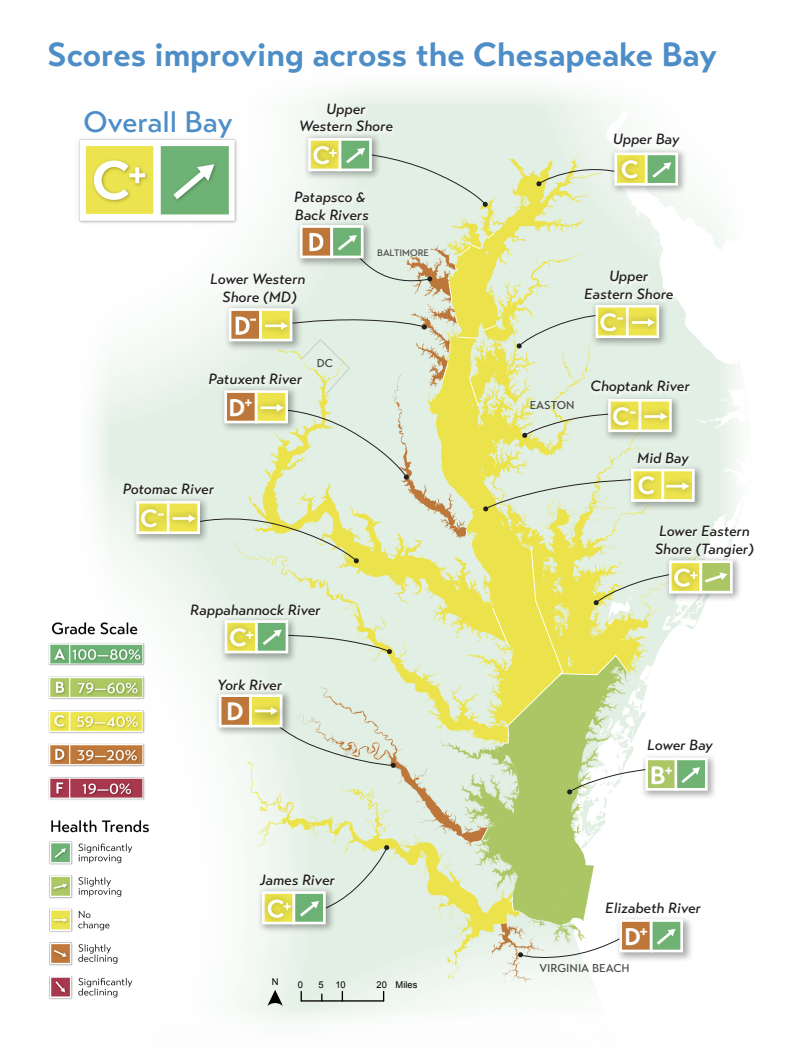
A map of the Chesapeake Bay Watershed shows areas in 2026 that have improved in water quality over the last year. (Map courtesy University of Maryland Center for Environmental Sciences)
Eight of the Bay’s 15 regions showed improvement, including the Patapsco and Back Rivers, Upper Western Shore, Rappahannock, Lower Eastern Shore, Upper Bay and Lower Bay.
The highest-scoring area was the lower Bay region with a B plus. This part of the Bay, stretching between Cape Henry and Cape Charles in Virginia, is aided with water from the Atlantic Ocean.
The lower Western Shore, which is bordered by the Patapsco River area on the north and extends down the coastline toward the Patuxent River, received the lowest score of D minus. It suffers from heavy runoff from urban areas.
A map of the Chesapeake Bay Watershed shows areas in 2026 that have improved in water quality over the last year. (Map courtesy University of Maryland Center for Environmental Sciences) The yearly report is conducted by the University of Maryland Center for Environmental Science (UMCES).
Researchers found that the level of pollutants that feed into the Bay have held steady or decreased. However the amounts of chlorophyll a, which causes harmful algae blooms, and the water clarity levels both worsened since last year.
A recent algae bloom in the Eastern Shore had devastating impacts on oyster farms in the area. The bloom is also reported to be connected to recent reports of fish kills, according to the Chesapeake Bay Foundation.
“This type of water quality data does take a long time to improve, and especially with the population pressure, development pressure that we have in our region, with large cities, large population centers, and also agriculture, and other types of pressures on the system like tourism,” said Alexandra Fries, program manager for UMCES.
“Even though we are managing and trying to restore, there’s still a lot of threats.
And so, the fact that we are seeing significantly improving trends is really promising.”
The progress in managing the Bay’s pollution levels is partly due to the Chesapeake Bay Watershed agreement that was first established in the late 1980s as a partnership between the six states and Washington D.C. whose waterways feed into the estuary.
The agreement set goals to reduce sediment and nutrients that end up in the Bay, make infrastructure improvements and follow agricultural best practices. The latest version of the agreement was signed in 2025, outlining new goals to meet by 2040.
“When you’re improving, when you’re on an upward trajectory, you don’t stop,” said UMCES President Fernando Miralles-Wilhelm. “You don’t cut funding, right? You double down on investments. And that’s what we need to continue to be doing.”
Earlier this month, The U.S. Environmental Protection Agency announced $37 million in grant funding, which would be matched by additional $53 million, for specific watershed and nutrient projects across the watershed.
The report indicated some improvements manifested because much of the watershed experienced a very dry year, with many regions recording droughts.
This means less water was running off of agricultural land and out of stormwater systems that might have otherwise carried pollutants into the Bay and connected waterways.
But scientists who compiled the report emphasized that other factors weighed heavily in the Bay’s progress.
“The score overall went up 6%. So having such a large increase, to me, is not just due to less precipitation,” Fries said. ”I think it’s also due to some of the restoration actions and best management practices that we’ve been putting in throughout the watershed.”
Key restoration wins that may have contributed to the improving scores include major investments in oyster habitat restoration.
The hard-shelled mollusks are natural filters for water. Combined, Virginia and Maryland restored and protected about 2400 acres of oyster reefs since the 2014 signing of the watershed agreement. Over 7.5 billion oysters were planted as part of the effort and more are planned for in the latest iteration of the agreement.
The report card also outlined grave threats to water quality over the past year, including the sewage pipe that burst near Cabin John in Maryland sent an estimated 243 million gallons of raw sewage into the Potomac River.
The disaster led to oyster harvest closures in some areas and demands from elected officials for more testing to be conducted.
The report card mirrors the continued efforts of state and local officials, scientists and communities to preserve and protect the Bay, the largest estuary in America and the third largest in the world.
“I actually get a question all the time: ‘Why are you all investing so much money and restoring the Chesapeake Bay?’” Serena Mcllwain, Maryland’s Secretary of the Department of the Environment, said at the announcement event.
“I just tell them, imagine if we didn’t spend any money. We wouldn’t progress, and we wouldn’t have the clean, beautiful Bay that we have today. Yes, it’s going to take continued investment. No, it’s not going to be solved tomorrow.
It means that we must continue to work in partnership.” |



 Oct 17, 2026